
Low Back PAin
Low back pain is the #1 cause of disability worldwide.
Back pain PRevalence
Causes of
Low Back PAin
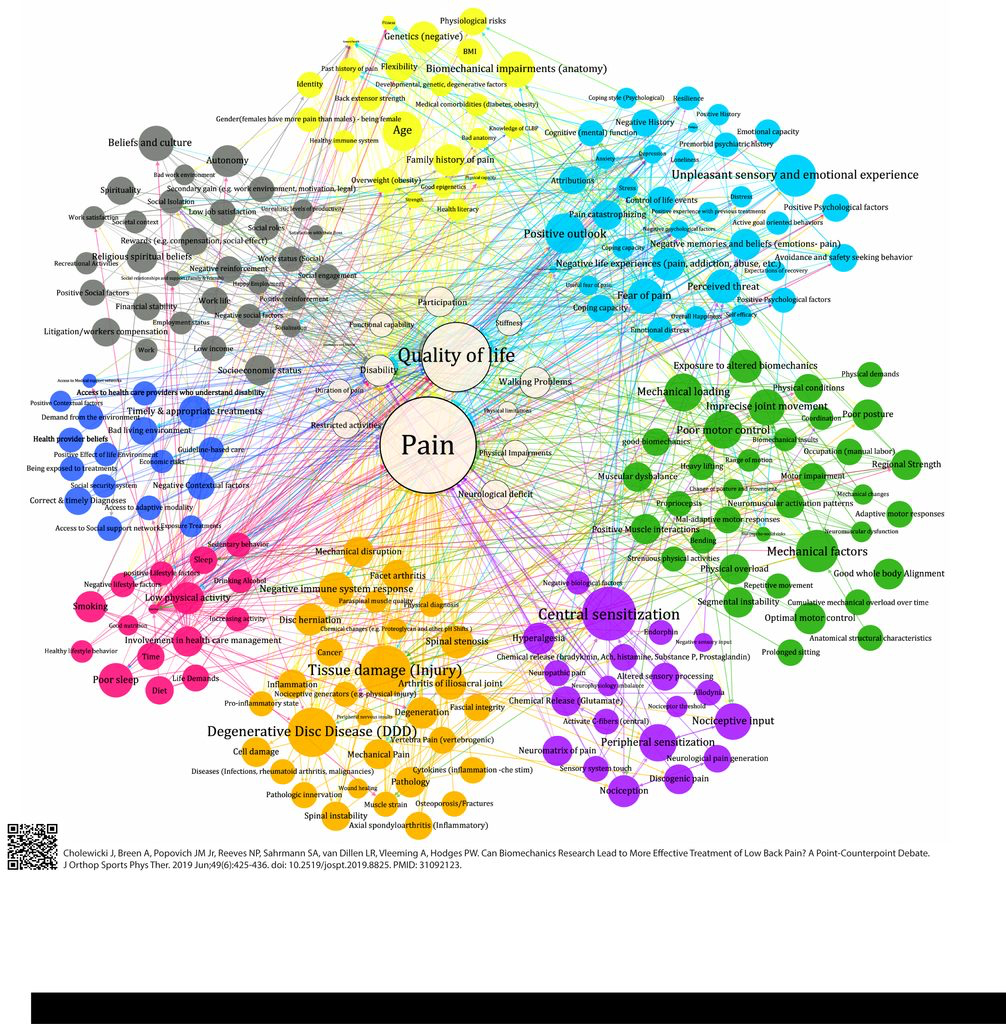
Approximately 85% of patients with low back pain cannot be given a precise diagnosis, despite the condition being the leading cause of worldwide disability.[1][2] This disconnect between the prevalence of low back pain and the inability to identify its specific source is perhaps the most counterintuitive aspect of the condition.
Imaging findings correlate poorly with symptoms. Herniated discs appear in 29% of asymptomatic 20-year-olds and 43% of asymptomatic 80-year-olds, with spontaneous regression occurring in more than 90% of sequestered discs and 70% of herniated discs within 2 years.[3] Similarly, spinal stenosis is found in 0-56% of asymptomatic individuals (median 11%).[3] This explains why interventions addressing structural pathology often fail while treatments with no effect on degenerative processes—such as psychological therapies—can profoundly improve pain and quality of life.[3]
Low back pain is increasingly understood as a long-lasting condition with a variable course rather than discrete, unrelated episodes.[4] While most acute episodes are short-lived, recurrent episodes are common: 54% of patients experience recurrent pain at 6 months and 47% at 24 months.[3] More than 60% of individuals with mechanical low back pain continue to have pain or frequent recurrences 1 year after onset.[3]
Reoccurence of pain can be attributed to the common, wait and see method. Where patients, place themselves on bedrest when they are burdened with low back pain. This leads to a loss of resilience in the affected tissues overtime and fear catastrophization.
The global burden is staggering and growing. Low back pain was responsible for 60.1 million disability-adjusted life-years in 2015—a 54% increase since 1990, with the largest increases in low-income and middle-income countries.[4] It ranks as the leading cause of worldwide productivity loss and the top cause of years lived with disability in 126 countries.[3]
References
Low Back Pain. Deyo RA, Weinstein JN. The New England Journal of Medicine. 2001;344(5):363-70. doi:10.1056/NEJM200102013440508.
Nonspecific Low Back Pain. Chiarotto A, Koes BW. The New England Journal of Medicine. 2022;386(18):1732-1740. doi:10.1056/NEJMcp2032396.
Low Back Pain. Knezevic NN, Candido KD, Vlaeyen JWS, Van Zundert J, Cohen SP. Lancet (London, England). 2021;398(10294):78-92. doi:10.1016/S0140-6736(21)00733-9.
What Low Back Pain Is and Why We Need to Pay Attention. Hartvigsen J, Hancock MJ, Kongsted A, et al. Lancet (London, England). 2018;391(10137):2356-2367. doi:10.1016/S0140-6736(18)30480-X.
Targeted Treatments
Chiropractic Adjustments
Myofascial Release
Dry Needing
Acupuncture
Therapeutic Exercise
